
Tags
Over the last couple of years, I have seen a lot of different ways how companies record and process their vendor invoices. Some people I talked to about vendor invoice processing mentioned that the standard invoice recording tools would not be sufficient, others stated that they are too complex and even one time I was confronted with the statement that the standard tools cannot be used because ‘everybody’ says that they are not mature enough. Many of those people resp. companies ended up implementing expensive software add-on’s that often had their own problems and required some customizations in the form of interfaces and alike. Against the background of those statements, I will illustrate within this and the following posts how expense and purchase order related vendor invoices can be processed in the standard Dynamics AX/365 for Operations application.
 Expense related vendor invoices are those for which no purchase order has been created and that are consequently not matched against product receipts.
The aim of this series is not to backfire on those previous – sometimes quite offensive – statements I was confronted with but rather to carve out the advantages and disadvantages, strength and weaknesses of the standard invoice recording tools in order to allow you making your own assessment.
Before we dig into the details, I would like to mention that all of the following illustrations and explanations will make use of what I call the vendor invoice ‘workbench’, that is, the ‘pending vendor invoice form’. Vendor invoice journals, vendor invoice register journals and invoice approval journals won’t be used at all because of the following reasons:
- The invoice workbench provides a single point of entry for entering expense related and purchase order related invoices.
- Entering vendor invoices through journals does not make use of the subledger accounting framework. As a result, important invoice audit functionalities are simply not available. For details, please have a look at this prior post
- Project related expense invoices that are recorded through journals are not considered as committed project cost. As a result, project costs might be observed too late, resulting in wrong decision makings and project analysis. For details, please have a look at the following post.
- The vendor invoice workbench allows recording project related intercompany expenses that cannot be recorded through the different invoice journals. What is more, intercompany projects automatically create intercompany invoices in the vendor invoice workbench. Using journals for recording vendor invoices consequently result in a situation where companies have to differentiate between (a) ordinary expense related invoices, (b) purchase order related invoices and (c) project related intercompany invoices and record them in different forms in Dynamics AX/365 for Operations.
Recording vendor invoices through the invoice workbench does also have some disadvantages, such as:
- That fact the value added tax included in the invoice amount will be posted later compared to posting it at the time the invoice is registered in the invoice register journal. This timing difference can result in cash flow related opportunity costs if the tax is deduced in future financial periods. Even though this statement is true, I have not seen many companies posting the value added tax at the time vendor invoices are registered. In addition, if the vendor invoice throughput time is short, the time difference argument falls short.
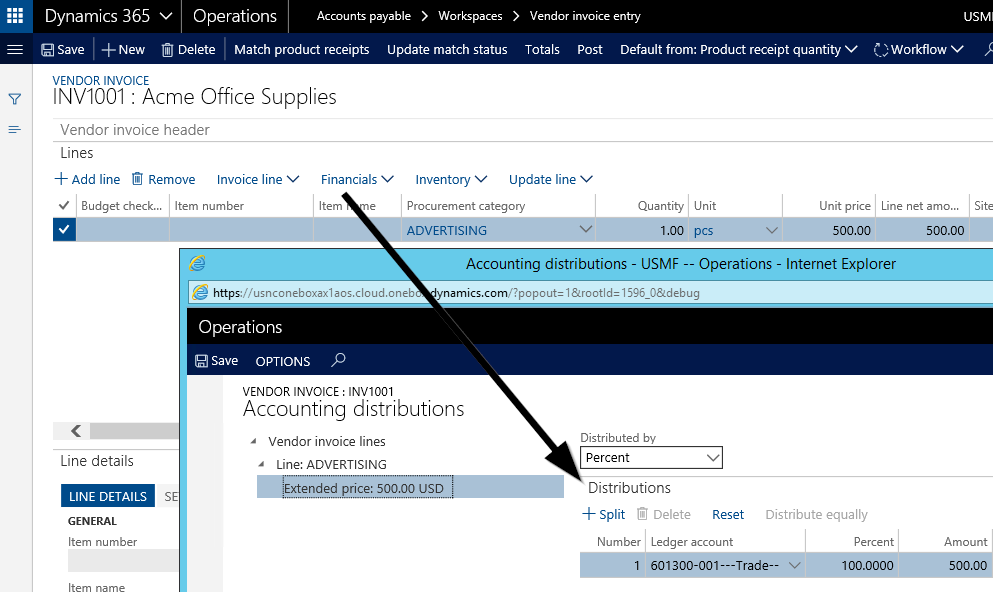
- That accountants who are used to recording expenses directly on ledger accounts have to relearn how they record vendor invoices. That is because the vendor invoice workbench does not allow entering ledger accounts directly but rather makes use of so-called procurement categories. The following figure illustrates an expense invoice for advertising expenses, where the ledger account that is assigned to the procurement category can be observed only indirectly through the accounting distribution form.
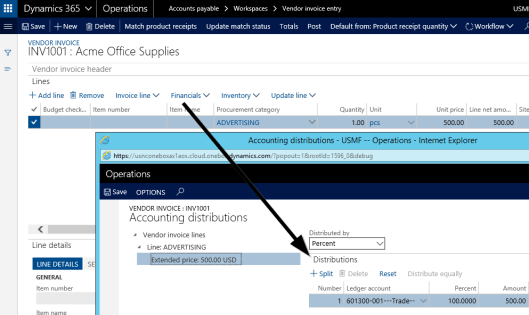
I made the experience that this last point is often the biggest hurdle that prevents people from using the vendor invoice workbench. From the authors perspective this second point is regularly used only as an excuse that is brought forward in order to prevent changes to familiar business processes. As an example, the argument that procurement categories do not provide users with an indication of the ledger account that will be used for posting can be overcome by including or adding the account number in the procurement category name.
The next posts will focus on expense related vendor invoices and how they can be entered and processed through the invoice workbench in Dynamics AX/365 for Operations. Thereafter, entering and processing purchase order related invoices will be illustrated before this series will conclude with a summary of the advantages/disadvantages, strength and weaknesses of the standard vendor invoice processing functionalities.
 Microsoft BizApps Finance & Controlling